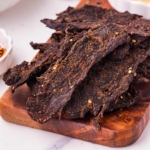
Venison Jerky
This homemade venison jerky combines lean deer meat with a savory soy sauce marinade, brown sugar and smoky spices. Adjust the heat and sweetness to taste, then dehydrate and finish with a short oven treatment.
Servings 16
Calories 109kcal
Ingredients
- 2-2 1/2 pounds boneless, lean venison, preferably a hindquarter cut such as top round, bottom round or eye of round weighed after trimming
- 1/2 cup Worcestershire sauce
- 1/2 cup soy sauce
- 3 tablespoons packed light brown sugar
- 1 tablespoon onion powder
- 1 tablespoon garlic powder
- 2 teaspoons smoked paprika
- 1 1/2 teaspoons coarsely ground black pepper
- 1 1/2 teaspoons crushed red pepper flakes or to taste
Instructions
- Using a sharp knife, remove all visible fat, silver skin and connective tissue from the venison. Slice into uniform strips 1/8–1/4 inch (0.3–0.6 cm) thick. For jerky that's easier to chew, slice against the grain (across the muscle fibers). For firmer, chewier jerky, slice with the grain (in the same direction as the fibers). Keep the strips as uniform as possible. In one batch, my thicker strips took an additional 2 hours to dry. Uneven slices also mean you'll need to do the final oven treatment in separate batches.
- In a large mixing bowl, whisk together the Worcestershire sauce, soy sauce, brown sugar, onion powder, garlic powder, smoked paprika, black pepper and crushed red pepper flakes until the brown sugar is mostly dissolved and the seasonings are evenly combined.
- Add the sliced venison and toss until all the strips are thoroughly coated. Cover and refrigerate for 8–24 hours, turning occasionally to redistribute the marinade.
- Drain the venison, allowing excess marinade to drip off. Pat dry with paper towels if desired. Discard the used marinade.
- Arrange the venison strips in a single layer on the dehydrator trays, leaving a little space between each piece. Don't overlap the strips.
- Set a temperature-controlled dehydrator to 140°F (60°C). Dehydrate until the strips are dry, checking individual pieces as they finish and rotating trays if necessary. The original recipe typically took 6–8 hours in a fixed-temperature dehydrator. At 140°F (60°C), drying may take considerably longer, with the National Center for Home Food Preservation giving a range of 10–24 hours for meat not heated before drying. Judge doneness by texture rather than time alone.
- To check for dryness, remove a strip and let it cool. Gently bend it in half. Properly dried jerky should bend and develop small surface cracks, with the meat fibers beginning to separate, without snapping completely in half. If the strip feels moist inside or bends without cracking, continue drying.
- Once the jerky is dry, preheat the oven to 275°F (135°C). Arrange the strips on a baking sheet in a single layer without touching or overlapping. Heat in the fully preheated oven for 10 minutes. This post-drying treatment is recommended by the National Center for Home Food Preservation for strips originally sliced no thicker than 1/4 inch (0.6 cm), and it was tested with this recipe without a noticeable change in texture.
- Allow properly heat-treated and thoroughly dried jerky to cool completely before transferring it to an airtight container or sealed bag. For a conservative approach, refrigerate and use within 1–2 weeks. For longer storage, freeze the cooled jerky in airtight freezer-safe bags or vacuum-sealed packages for up to 2 years. Portioning it before freezing makes it easy to remove just what you need. Thaw in the refrigerator.
Notes
- Timing - the total time is based on 8 hours of marinating and 10 hours of dehydrating. Marinating can take up to 24 hours, and dehydrating may take 10–24 hours. Allow additional time for cooling.
- Liquid aminos - can replace soy sauce 1:1, with no noticeable difference in flavor.
- Brown sugar - omit for a savory version, use less for a subtler sweetness, or increase to 1/4 cup (50 grams) for sweeter jerky.
- Spice level - 1 1/2 teaspoons of crushed red pepper flakes produces mild heat. Increase to 1 tablespoon for noticeably spicier jerky, or reduce or omit for less heat.
- Gluten-free option - use gluten-free soy sauce or verified gluten-free liquid aminos and gluten-free Worcestershire sauce.
- The nutrition information provided is calculated as a courtesy and is only an estimate. I am not a licensed nutritionist or dietitian. For the most accurate nutritional data, consult a professional or use your preferred calculator.
Nutrition
Serving: 1 ounce (28 grams) | Calories: 109kcal | Carbohydrates: 5g | Protein: 17g | Fat: 2g | Saturated Fat: 1g | Polyunsaturated Fat: 0.4g | Monounsaturated Fat: 0.5g | Cholesterol: 60mg | Sodium: 557mg | Potassium: 335mg | Fiber: 0.4g | Sugar: 3g | Vitamin A: 187IU | Vitamin C: 1mg | Calcium: 20mg | Iron: 3mg