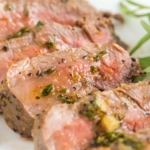
Venison Tenderloin
This venison tenderloin is incredibly tender and juicy, enhanced by a quick sear and a simple fresh herb garlic butter. It's an excellent option for a special dinner for two and is naturally gluten-free and keto-friendly.
Servings 2
Calories 358kcal
Ingredients
Dry rub:
- 1 1/4 to 2 1/2 teaspoons sea salt see notes
- 1 teaspoon medium-coarse black pepper
- 1 teaspoon garlic powder
To cook the meat:
- 1 venison tenderloin about 1/2 to 1 pound (225 to 450 grams)
- 1 tablespoon canola oil, grapeseed or avocado oil
Herb butter:
- 1/4 cup unsalted butter
- 4 garlic cloves 16 grams, peeled, minced
- 4 teaspoons fresh finely chopped rosemary from about four 6” sprigs or 1 1/2 teaspoons dried
- 2 teaspoons fresh thyme from about eight 4” sprigs or 3/4 teaspoon dried
- 1/4 teaspoon salt
Instructions
- Combine the sea salt, black pepper and garlic powder in a small bowl.1 1/4 to 2 1/2 teaspoons sea salt, 1 teaspoon medium-coarse black pepper, 1 teaspoon garlic powder
- Pat the venison tenderloin dry with paper towels, then rub the seasoning mixture evenly over the entire tenderloin.
- Place the seasoned tenderloin uncovered in the refrigerator for at least 40 minutes or up to 24 hours.
- Remove the tenderloin from the refrigerator about 1 hour before cooking. If your tenderloin is especially large or thick and may need an oven finish, preheat the oven to 375 °F (190 °C).
- Pat the tenderloin dry again. Heat a cast iron skillet over high heat until very hot. Add the oil, then reduce the heat to medium-high.1 venison tenderloin, 1 tablespoon canola oil, grapeseed or avocado oil
- Add the tenderloin and sear until well browned, turning as needed to brown all sides. Don’t force the meat from the skillet; if it sticks when you try to turn it, let it cook a little longer until it releases more easily.
- Continue cooking the tenderloin in the skillet until it reaches your desired internal temperature. If the outside is well browned but the center still needs more time, transfer the oven-safe skillet to the preheated oven and cook until the tenderloin reaches 120-130 °F (49-54 °C) for the medium-rare result used in this recipe. Just note that USDA food-safety guidance for venison recommends a higher internal temperature of 160 °F (71 °C).
- Transfer the tenderloin to a plate and let it rest for 5-15 minutes. The internal temperature should continue to rise, reaching approximately 130-135 °F (54-57 °C). Keep the tenderloin whole while it rests, then slice it into medallions.
- While the venison rests, drain off any excess oil from the skillet if needed, but don’t wipe out the pan. Return the skillet to medium-low heat and add the butter, garlic, rosemary, thyme and salt.1/4 cup unsalted butter, 4 garlic cloves, 4 teaspoons fresh finely chopped rosemary, 2 teaspoons fresh thyme, 1/4 teaspoon salt
- Cook for 1-3 minutes, scraping up the browned bits from the bottom of the skillet, until the garlic is softened. Spoon the garlic herb butter over the sliced venison and serve.
Notes
- How much salt to use:
- for 1/2 pound (227 grams) tenderloin, use 1 1/4 teaspoons
- for 3/4 pound (340 grams), use 2 teaspoons
- for 1 pound (458 grams), use 2 1/2 teaspoons
- If you can’t rub on the seasoning at least 40 minutes before cooking, put it on immediately before cooking. Otherwise, juices will be lost, making it more difficult to sear the meat properly. If you refrigerate it, remember to let it sit at room temp for 1 hour before cooking.
- 1 tenderloin is enough for 2-4 people, depending on how big your meat servings are. I would say it's enough for 2 adults and 2 small kids, but not 4 adults. However, if your tenderloin is on the smaller side, it may only be enough for 2 adults.
- The nutrition information provided is calculated as a courtesy and is only an estimate. I am not a licensed nutritionist or dietitian. For the most accurate nutritional data, consult a professional or use your preferred calculator.
Nutrition
Calories: 358kcal | Carbohydrates: 4g | Protein: 16g | Fat: 31g | Saturated Fat: 16g | Polyunsaturated Fat: 3g | Monounsaturated Fat: 11g | Trans Fat: 1g | Cholesterol: 101mg | Sodium: 2360mg | Potassium: 266mg | Fiber: 1g | Sugar: 0.1g | Vitamin A: 811IU | Vitamin C: 5mg | Calcium: 34mg | Iron: 3mg