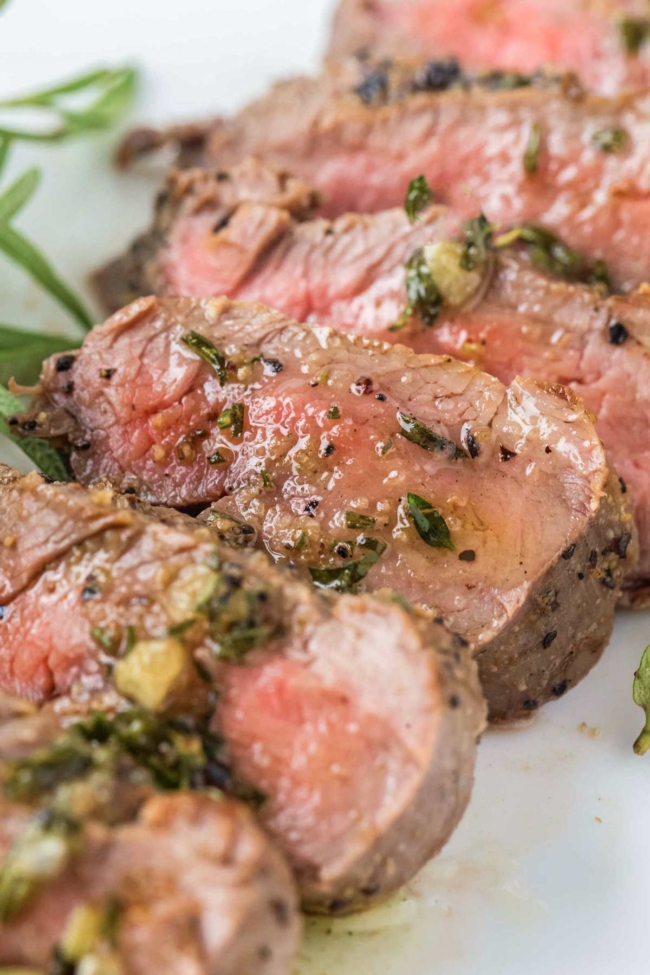
This venison tenderloin recipe is pan-seared in a hot cast iron skillet and finished with an easy garlic herb butter. The tenderloin stays whole while it cooks, giving you a browned crust on the outside and juicy meat inside. It’s naturally gluten-free and keto, too.
Deer tenderloin is already one of the most tender cuts of venison, so it doesn’t need a complicated marinade or a long cooking time. The biggest thing is not to overcook it. Most tenderloins are small enough to cook entirely on the stovetop, although an especially large or thick one can be finished briefly in the oven.
Is backstrap the same as tenderloin?
No. Venison backstrap and tenderloin are two different cuts, even though the terms are sometimes used interchangeably.
The backstrap is the long loin muscle that runs along the outside of the spine. The true tenderloin is much smaller and is located inside the abdominal cavity near the spine. Both are tender cuts, but they aren’t the same piece of meat.
If you have the larger loin rather than the small inner tenderloin, use my Venison Backstrap recipe instead. That recipe is designed for the larger cut and uses a slightly different cooking method.

Ingredients
Please scroll down for the full recipe. These are just notes on select ingredients.
For the dry rub
- Sea salt – seasoning the meat ahead of time gives the salt time to work its way into the tenderloin.
- Black pepper – medium-coarse black pepper adds flavor without overpowering the venison.
- Garlic powder – adds garlic flavor to the crust, while fresh garlic is used later in the butter.
For the meat
- Venison tenderloin – keep the tenderloin whole while cooking if possible. If it’s too long to fit in your skillet, cut it in half crosswise. If you’re using frozen venison, thaw it completely in the refrigerator first.
- Oil – use an oil with a high smoke point, such as canola, avocado, peanut, grapeseed or sunflower oil. The skillet needs to get very hot to give the tenderloin a good sear.
For the herb butter
- Unsalted butter – adds richness to the very lean venison and picks up the flavorful browned bits left in the skillet.
- Garlic cloves – fresh garlic is cooked briefly in the butter after the venison comes out of the skillet.
- Fresh rosemary – or use 1 1/2 teaspoons dried rosemary.
- Fresh thyme – or use 3/4 teaspoon dried thyme.

How to cook venison tenderloin
This deer tenderloin recipe is primarily cooked in a cast iron skillet. Because tenderloin is such a small, lean cut, a quick sear is usually all it needs. You only need the oven if your tenderloin is unusually large or thick.

- Season – mix the sea salt, black pepper and garlic powder. Pat the venison tenderloin dry, coat it all over with the seasoning and refrigerate it uncovered for at least 40 minutes or up to 24 hours.
- Prepare the meat – take the tenderloin out of the refrigerator about 1 hour before cooking. Pat the surface dry again before searing.
- Heat the skillet – heat a cast iron skillet over high heat until very hot, then add the oil.
- Sear – add the tenderloin and sear over medium-high heat, turning it as each side develops a browned crust. If the meat is sticking strongly when you try to turn it, give it a little more time.
- Finish cooking – most smaller tenderloins can finish cooking entirely on the stovetop. If yours is especially large or thick, transfer the oven-safe skillet to a preheated 375 °F (190 °C) oven after searing. Use a meat thermometer rather than relying on cooking time alone.
- Rest – transfer the venison to a plate and let it rest before cutting it into medallions.
- Make the herb butter – while the venison rests, add the butter, garlic, rosemary, thyme and salt to the skillet. Scrape up the browned bits and cook just until the garlic is softened, then spoon the butter over the sliced tenderloin.

Tips for success
- Season ahead – season the tenderloin at least 40 minutes before cooking if possible. You can also season it up to 24 hours ahead and refrigerate it uncovered.
- Dry the surface – pat the tenderloin dry before searing. Excess moisture makes it harder to develop a browned crust.
- Get the skillet hot – venison tenderloin cooks quickly, so you want the skillet hot enough to brown the outside without having to leave the meat in the pan for a long time.
- Don’t force it off the pan – if the tenderloin is sticking when you try to turn it, give it a little longer. It should release more easily once the crust has formed.
- Brown all sides – tenderloin is rounded rather than flat like a steak, so turn it as needed to sear the entire outside.
- Use a meat thermometer – venison is very lean, so overcooking can quickly make it dry and tough.
- Rest before slicing – keep the tenderloin whole while it rests, then slice it into medallions just before serving.
Do you need to finish venison tenderloin in the oven?
Usually, no. Deer tenderloin is relatively small and can often cook all the way through in the skillet after you sear it on all sides.
The oven is helpful if your tenderloin is particularly large or thick and the outside is already nicely browned before the center reaches your desired temperature. In that case, transfer the oven-safe skillet to a preheated 375 °F (190 °C) oven after searing and finish it there.
There’s no need to use the oven automatically. The size and thickness of your tenderloin and its internal temperature will tell you whether it needs additional cooking.
Venison tenderloin internal temperature
A meat thermometer is especially useful for venison tenderloin because this cut is so lean. For the medium-rare result in this recipe, cook the tenderloin until it reaches about 120-130 °F (49-54 °C), then let it rest. The temperature should continue to rise as the meat rests, reaching approximately 130-135 °F (54-57 °C).
This recipe gives temperatures for medium-rare venison. Just note that USDA food-safety guidance for venison recommends a higher internal temperature of 160 °F (71 °C).
Venison tenderloin is especially prone to becoming dry and tough when overcooked, so start checking the temperature early rather than relying on cooking time alone.

Do you need to soak deer tenderloin?
No. Deer tenderloin is naturally tender, so it doesn’t need to be soaked in milk, buttermilk, vinegar or brine to tenderize it.
Venison can have a stronger flavor than beef, and the flavor varies depending on the deer and how the meat was handled and processed. If you personally prefer soaking venison to mellow its flavor, you can, but it isn’t necessary for this recipe.
If you do soak or marinate the tenderloin, pat it very dry before seasoning and searing. A wet surface makes it much harder to get a good crust.

Garlic herb butter
The garlic herb butter is made right in the skillet using the flavorful browned bits left behind by the venison. It adds richness to this very lean cut without covering up the flavor of the meat.
Once the tenderloin has been removed from the skillet and set aside to rest, drain off excess oil if necessary, but don’t clean the pan. Return it to medium-low heat and add the butter, garlic, rosemary, thyme and salt.
Use a wooden spoon or spatula to scrape up the browned bits from the bottom. Cook for 1-3 minutes, just until the garlic has softened, then spoon the rosemary and thyme garlic butter over the sliced venison.

How much does a venison tenderloin serve?
Venison tenderloins are much smaller than many people expect. A tenderloin may weigh roughly 1/2 to 1 pound (225 to 450 grams), although the size varies considerably depending on the animal.
A 1/2-pound (225-gram) tenderloin generally serves about 2 people. A tenderloin closer to 1 pound (450 grams) can serve 3-4, depending on portion sizes and the sides you serve with it.
If you’re looking for something that serves more people, my Venison Steaks recipe uses a more affordable cut of meat and serves 4. Both those and this tenderloin would go great with some sauteed mushrooms, asparagus or other roasted vegetables.
How to store
Let leftover venison cool, then place it in an airtight container and refrigerate it for up to 3-4 days.
If you want to keep it longer, wrap the venison well and transfer it to a freezer-safe bag or container. Freeze it for up to 3-6 months.
More Venison Recipes
Have more venison in your freezer? Here are a few other ways to use it.
- Venison Chili – a hearty, easy dinner made with ground venison, with stovetop and slow cooker directions.
- Venison Stew – a comforting, slow-cooked meal with tender venison and vegetables.
- Venison Burgers – juicy, flavorful burgers made with ground venison in a cast iron skillet.
- Venison Casserole – a cheesy baked ziti with ground venison, a rich tomato sauce and creamy layers of sour cream and mozzarella. Easy to make gluten-free!
- Venison Bolognese – a rich, flavorful pasta sauce made with ground venison that’s ready in about an hour. Easy to make gluten-free and dairy-free!
I hope you’ll enjoy this venison tenderloin! I’d love for you to leave a comment down below if you try it out. Thanks!

Venison Tenderloin
Ingredients
Dry rub:
- 1 1/4 to 2 1/2 teaspoons sea salt see notes
- 1 teaspoon medium-coarse black pepper
- 1 teaspoon garlic powder
To cook the meat:
- 1 venison tenderloin about 1/2 to 1 pound (225 to 450 grams)
- 1 tablespoon canola oil, grapeseed or avocado oil
Herb butter:
- 1/4 cup (56 grams) unsalted butter
- 4 garlic cloves 16 grams, peeled, minced
- 4 teaspoons fresh finely chopped rosemary from about four 6” sprigs or 1 1/2 teaspoons dried
- 2 teaspoons fresh thyme from about eight 4” sprigs or 3/4 teaspoon dried
- 1/4 teaspoon salt
Instructions
- Combine the sea salt, black pepper and garlic powder in a small bowl.1 1/4 to 2 1/2 teaspoons sea salt1 teaspoon medium-coarse black pepper1 teaspoon garlic powder
- Pat the venison tenderloin dry with paper towels, then rub the seasoning mixture evenly over the entire tenderloin.
- Place the seasoned tenderloin uncovered in the refrigerator for at least 40 minutes or up to 24 hours.
- Remove the tenderloin from the refrigerator about 1 hour before cooking. If your tenderloin is especially large or thick and may need an oven finish, preheat the oven to 375 °F (190 °C).
- Pat the tenderloin dry again. Heat a cast iron skillet over high heat until very hot. Add the oil, then reduce the heat to medium-high.1 venison tenderloin1 tablespoon canola oil, grapeseed or avocado oil
- Add the tenderloin and sear until well browned, turning as needed to brown all sides. Don’t force the meat from the skillet; if it sticks when you try to turn it, let it cook a little longer until it releases more easily.
- Continue cooking the tenderloin in the skillet until it reaches your desired internal temperature. If the outside is well browned but the center still needs more time, transfer the oven-safe skillet to the preheated oven and cook until the tenderloin reaches 120-130 °F (49-54 °C) for the medium-rare result used in this recipe. Just note that USDA food-safety guidance for venison recommends a higher internal temperature of 160 °F (71 °C).
- Transfer the tenderloin to a plate and let it rest for 5-15 minutes. The internal temperature should continue to rise, reaching approximately 130-135 °F (54-57 °C). Keep the tenderloin whole while it rests, then slice it into medallions.
- While the venison rests, drain off any excess oil from the skillet if needed, but don’t wipe out the pan. Return the skillet to medium-low heat and add the butter, garlic, rosemary, thyme and salt.1/4 cup (56 grams) unsalted butter4 garlic cloves4 teaspoons fresh finely chopped rosemary2 teaspoons fresh thyme1/4 teaspoon salt
- Cook for 1-3 minutes, scraping up the browned bits from the bottom of the skillet, until the garlic is softened. Spoon the garlic herb butter over the sliced venison and serve.
Notes
- How much salt to use:
- for 1/2 pound (227 grams) tenderloin, use 1 1/4 teaspoons
- for 3/4 pound (340 grams), use 2 teaspoons
- for 1 pound (458 grams), use 2 1/2 teaspoons
- If you can’t rub on the seasoning at least 40 minutes before cooking, put it on immediately before cooking. Otherwise, juices will be lost, making it more difficult to sear the meat properly. If you refrigerate it, remember to let it sit at room temp for 1 hour before cooking.
- 1 tenderloin is enough for 2-4 people, depending on how big your meat servings are. I would say it's enough for 2 adults and 2 small kids, but not 4 adults. However, if your tenderloin is on the smaller side, it may only be enough for 2 adults.
- The nutrition information provided is calculated as a courtesy and is only an estimate. I am not a licensed nutritionist or dietitian. For the most accurate nutritional data, consult a professional or use your preferred calculator.









Comments & Reviews
Maria says
I made this for a fancy dinner party my husband had for work, and it was a showstopper. The tenderloin was so tender it practically melted in my mouth. My guests couldn’t stop talking about it. I hope to get my hands on some more venison soon! We are fresh out.
Ben says
This was the first of your venison recipes I tried and what got me hooked! This came out so, so perfect. I made it for our anniversary and my wife was thrilled. I even felt a bit proud. She normally cooks the tenderloin. Thank you very much for all your wonderful venison recipes. Please share more of them!
Erin @ Easy Wholesome says
Aww, yay! I’m so glad that she loved it and that you could feel proud of it. 🙂 I just posted a new venison recipe and I have even more coming! Thanks so much for your comment.