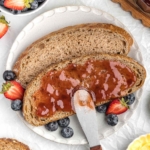
Whole Wheat Sourdough Bread
This 50/50 whole wheat sourdough bread combines equal parts bread flour and whole wheat flour for plenty of whole wheat flavor with a soft, well-structured crumb. The higher-hydration dough can be mixed by hand or stand mixer and cold-proofed overnight before baking.
Servings 12 slices
Calories 148kcal
Ingredients
Levain:
- 25 grams ripe 100%-hydration sourdough starter
- 25 grams bread flour I used King Arthur Bread Flour
- 25 grams whole wheat flour I used King Arthur Whole Wheat Flour
- 50 grams water
Dough:
- 225 grams bread flour
- 225 grams whole wheat flour
- 350 grams water plus up to 35 grams additional water as needed
- 125 grams ripe levain
- 11 grams fine sea salt
Instructions
Prepare the levain:
- Combine the sourdough starter, bread flour, whole wheat flour and water. Mix until no dry flour remains. Cover and let the levain rise at room temperature until it is bubbly, active and near its peak, about 3-5 hours depending on temperature and starter activity.25 grams ripe 100%-hydration sourdough starter, 25 grams bread flour, 25 grams whole wheat flour, 50 grams water
Autolyse:
- Add the bread flour, whole wheat flour and 350 grams water to a large mixing bowl. Mix until all of the flour is hydrated and no dry spots remain.225 grams bread flour, 225 grams whole wheat flour, 350 grams water
- Cover and let the dough rest for 30 minutes.
- This is an autolyse, which allows the flour to fully hydrate and begins gluten development before the levain and salt are added.
If mixing the dough by hand:
- Add the ripe levain to the autolysed dough. Work it into the dough by gently pinching, folding and squeezing until the levain is evenly incorporated.125 grams ripe levain
- Cover and let the dough rest for about 20 minutes.
- Sprinkle the salt evenly over the dough and work it in thoroughly. Begin adding up to 35 grams additional water gradually, working the dough between additions.11 grams fine sea salt
- You may not need all of the additional water. The goal is a soft, cohesive dough that is tacky but still has enough strength to hold together. If the dough becomes excessively loose or difficult to handle, stop adding water.
- When the additional water is added, the dough may temporarily look loose, slippery or even as though it has started to fall apart. This is normal. Continue mixing, folding and working the dough, and it will begin to come back together as the gluten develops.
- Cover and let the dough rest for 30 minutes.
If using the stand mixer method:
- After the 30-minute autolyse, add the ripe levain to the dough and mix using the dough hook on low speed for about 3-4 minutes, or until the levain is fully incorporated and the dough looks cohesive.125 grams ripe levain
- Add the salt, then gradually add up to 35 grams additional water while mixing on low speed. You may not need all of the water. Add it slowly and allow each addition to incorporate before adding more.11 grams fine sea salt
- The dough may look loose or messy when the additional water is first incorporated. Continue mixing briefly until the dough comes back together. It does not need to reach a full windowpane at this stage.
- Cover and let the dough rest for 30 minutes.
- Continue with the stretch-and-folds during bulk fermentation as directed below.
Bulk fermentation and stretch-and-folds:
- Once the dough has rested, begin the bulk fermentation stage.
- Perform 3 sets of stretch-and-folds, spaced about 30 minutes apart.
- For each set, gently stretch one side of the dough upward and fold it over itself. Rotate the bowl and repeat on all four sides. Avoid aggressively stretching the dough, especially as it becomes more aerated.
- After the third set, assess the dough. If it already feels strong and smooth and holds its shape well, no additional folds are necessary. If it still feels loose or lacks structure, perform a fourth set.
- Continue bulk fermentation after the final set of folds until the dough has visibly risen and looks noticeably aerated and puffy. You should see bubbles developing along the sides and surface, and the dough should have a soft, pillowy appearance with a gentle jiggle when the bowl is moved.
- Because this dough contains 50% whole wheat flour, fermentation can move more quickly than a mostly-white sourdough. Rather than waiting for the dough to double in size, use the appearance and feel of the dough to determine when bulk fermentation is complete.
Preshape:
- Turn the dough out onto a lightly floured work surface.
- Gently shape it into a loose round, using a bench scraper to help create some surface tension without pressing the air out of the dough.
- Let the dough rest uncovered for about 20 minutes.
Final shape:
- Lightly flour the top of the dough and carefully flip it over so the floured side is underneath.
- Shape the dough into a tight boule, creating enough surface tension for the loaf to hold its shape while still being gentle enough to preserve the fermentation you've developed.
- Place the shaped dough seam-side up in a well-floured 9-10-inch (23-25-cm) banneton.
- Cover and refrigerate for 10-14 hours.
Bake:
- Place a Dutch oven with the lid on in the oven and preheat to 475°F (245°C) for about 30 minutes.
- When ready to bake, carefully turn the cold dough onto a piece of parchment paper.
- If there is excess flour on the surface, lightly mist the loaf with water to reduce the floury appearance. Do not saturate the dough.
- Score the loaf with a lame or sharp razor.
- Carefully transfer the dough to the preheated Dutch oven and cover with the lid.
- Bake at 475°F (245°C) for 25 minutes.
- Check the internal temperature in the center of the loaf. It should be around 190°F (88°C) or higher before removing the lid. If it is still considerably below 190°F (88°C), continue baking covered for a few additional minutes and check again.
- Once the loaf reaches around 190°F (88°C) or higher, remove the lid and reduce the oven temperature to 450°F (230°C).
- Continue baking uncovered for about 20-25 minutes, or until the loaf is deeply golden brown and the internal temperature reaches 205-210°F (96-99°C).
- For more even browning, you can carefully transfer the loaf to an oven-safe wire rack set over a baking sheet for the final few minutes of baking.
- Remove the bread from the oven and allow it to cool completely on a wire rack before slicing. For the best crumb texture, allow at least 2 hours of cooling time.
Notes
- Costco Organic All-Purpose Flour was also tested successfully in place of the bread flour. Because flour strength and absorption vary, other all-purpose flours may behave differently.
- You may not need all 35 grams of additional water. A version using 370 grams total added water was also tested successfully. Add the water gradually and stop when the dough is soft, tacky and cohesive but still strong enough to hold together.
- Don't wait for the dough to double during bulk fermentation. Look for visible expansion, bubbles, a pillowy texture and a gentle jiggle when the bowl is moved.
- A 10-14 hour cold proof works well. Fermentation continues in the refrigerator, and significantly extending the proof beyond about 14-16 hours can increase the risk of overproofing.
- The nutrition information provided is calculated as a courtesy and is only an estimate. I am not a licensed nutritionist or dietitian. For the most accurate nutritional data, consult a professional or use your preferred calculator.
Nutrition
Calories: 148kcal | Carbohydrates: 31g | Protein: 5g | Fat: 1g | Saturated Fat: 0.1g | Polyunsaturated Fat: 0.4g | Monounsaturated Fat: 0.1g | Sodium: 358mg | Potassium: 97mg | Fiber: 3g | Sugar: 0.1g | Vitamin A: 2IU | Calcium: 11mg | Iron: 1mg