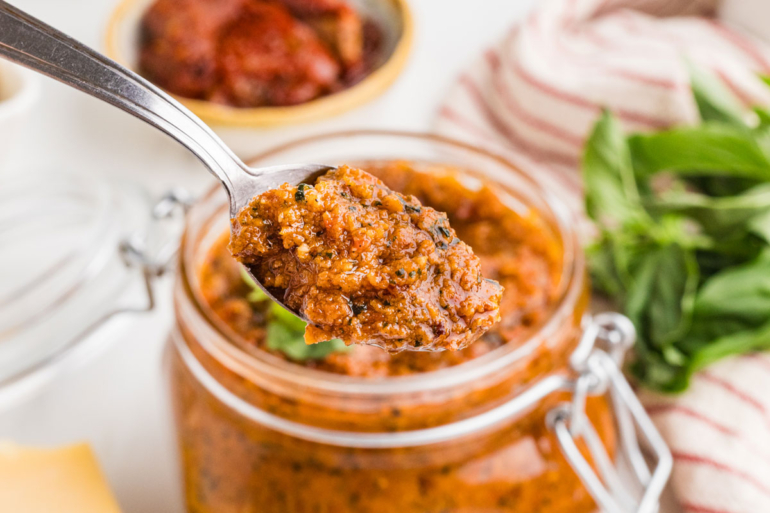
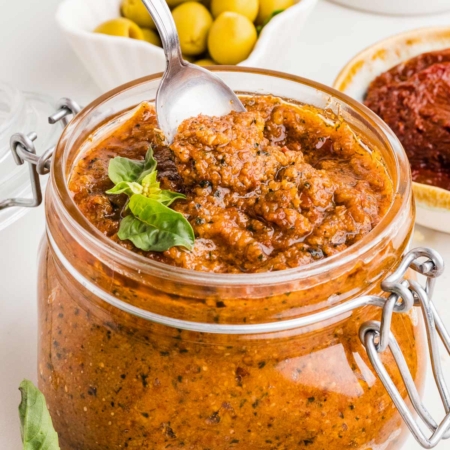
This sun-dried tomato pesto is rich, savory, and packed with concentrated tomato flavor, with toasted almonds, fresh basil, Parmesan, garlic, and green olives for a subtle tang. It has a thick, spreadable texture and a deeper, more intensely savory flavor than traditional basil pesto.
Unlike Genovese-style pesto, which is centered around fresh basil and pine nuts, this version gets much of its flavor and color from sun-dried tomatoes. I use almonds instead of pine nuts for a slightly rustic texture, while a small amount of green olive adds extra savory flavor without making the pesto taste noticeably olive-forward.
It takes about 15 minutes to make, and there’s no blanching or other complicated preparation. The sun-dried tomatoes, almonds, garlic, and black pepper are briefly toasted in a skillet before everything is processed together. This quick step deepens the flavor and gives the almonds a lightly toasted taste.
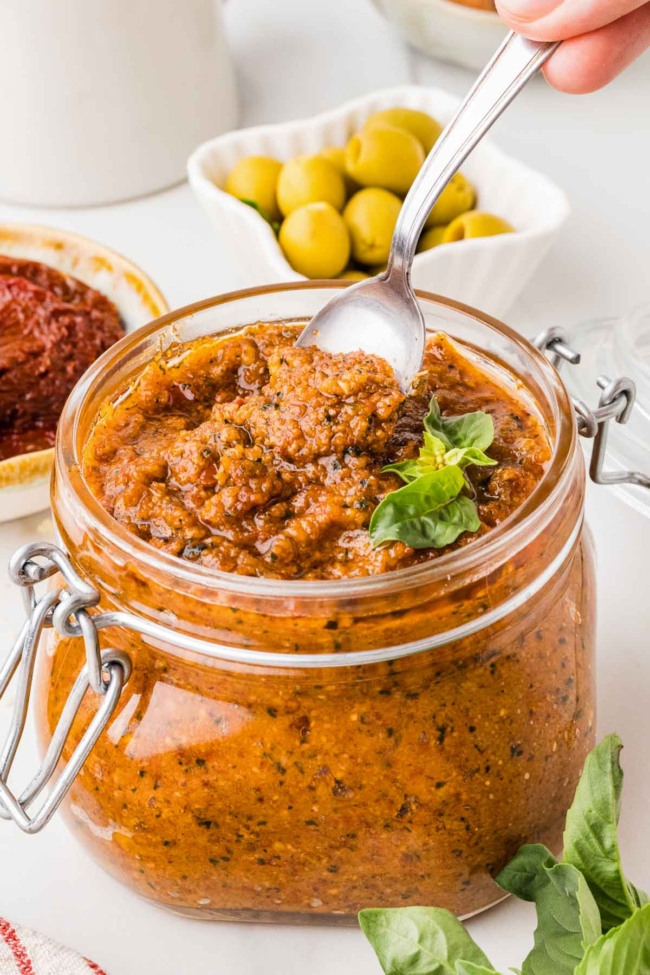
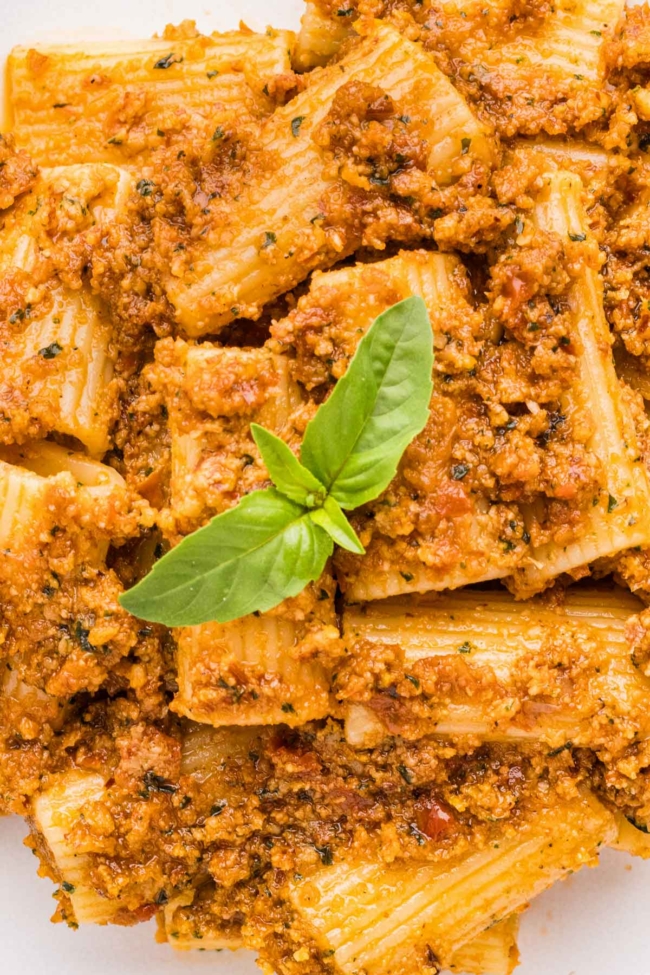
You can toss it with hot pasta and a little pasta water for a creamy sauce, spread it on crusty bread, serve it with crackers, or use it as a flavorful sandwich spread. I especially like it on olive sourdough bread, where the savory pesto and toasted almonds really stand out.
It’s also easy to make ahead and keeps in the refrigerator for up to 5 days. You can freeze it in individual portions, too, so you have homemade pesto ready whenever you need a quick meal or snack.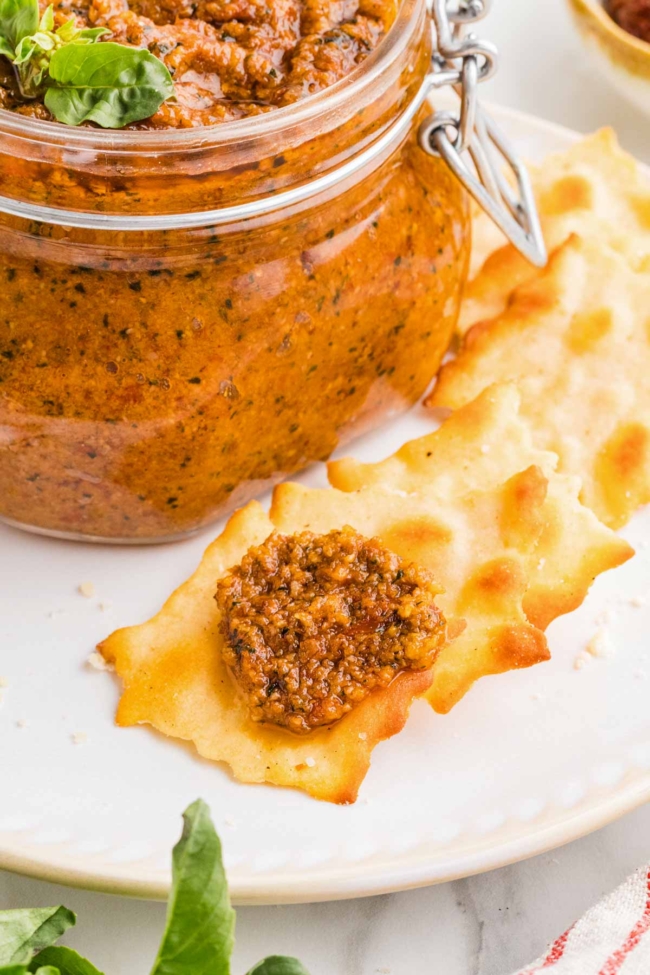
What’s To Love
- Ready in about 15 minutes.
- Uses almonds for a slightly rustic texture and plenty of flavor.
- Great with pasta, bread, crackers, and sandwiches.
- Easy to make ahead and freeze in individual portions.
- Can be made vegan with plant-based Parmesan or nutritional yeast.
Ingredient notes
Please scroll down for the full recipe. These are just some notes on select ingredients.
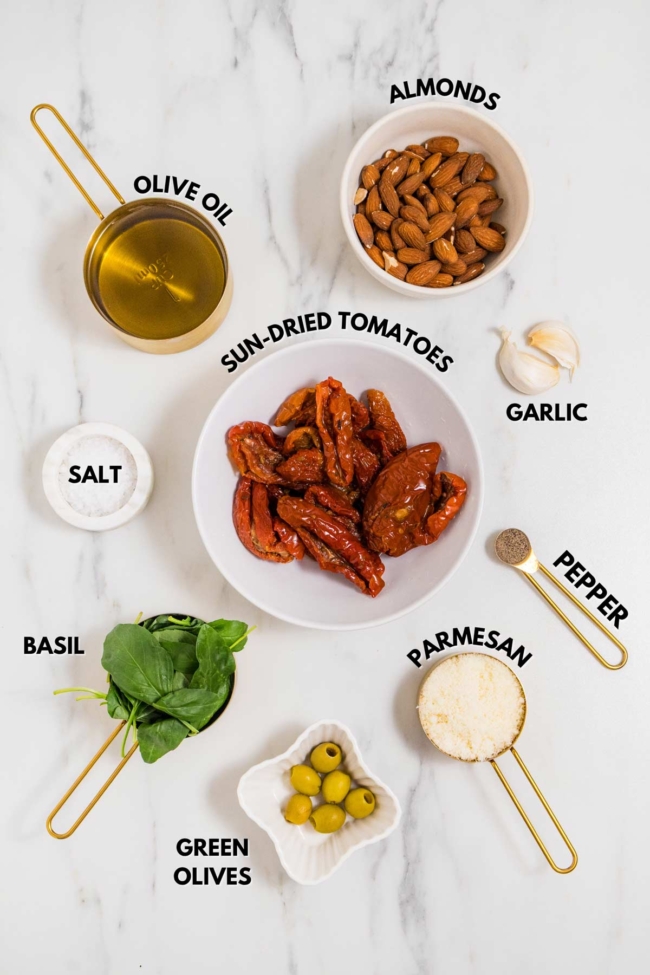
- Sun-dried tomatoes – use tomatoes packed in oil and drain them without rinsing. Plain tomatoes give a more subtle flavor, while herb-infused tomatoes add extra seasoning. You can also use dry-packed tomatoes, but they’ll need to be rehydrated first. Put the sun-dried tomatoes in a bowl. Cover completely with boiling water and let them sit for 15–20 minutes until softened. Drain well and pat them dry with paper towels.
- Almonds – regular almonds give the pesto a slightly rustic texture. For a smoother pesto, use blanched almonds instead. Walnuts, pine nuts, or cashews can also be used in the same amount by weight, although the flavor and texture will vary slightly.
- Garlic – briefly cooking the sliced garlic with the tomatoes and almonds takes the sharp edge off and gives it a deeper flavor.
- Parmesan – freshly grated Parmesan gives the best texture and flavor. Grana Padano is the closest substitute. Pecorino Romano or Pecorino Siciliano also work, although they make the pesto saltier and more assertive.
- Fresh basil – use fresh, good-quality basil. Basil that is old or beginning to turn gray can develop a bitter flavor. I don’t recommend using frozen basil.
- Green olives – the olives add a little acidity and saltiness that helps balance the richness of the tomatoes and olive oil. They aren’t prominent in the finished pesto, so you can leave them out if needed.
- Extra-virgin olive oil – because olive oil makes up most of the liquid in this recipe, its flavor matters. Use an extra-virgin olive oil that you enjoy the taste of. The recipe uses fresh olive oil rather than relying on the oil from the tomato jar because the quality of packing oils varies between brands. If you trust the quality of your tomato packing oil, you can use some of it as part of the olive oil in the recipe, keeping the total amount added during processing at 3/4 cup plus 1 tablespoon.
How to make sun-dried tomato pesto
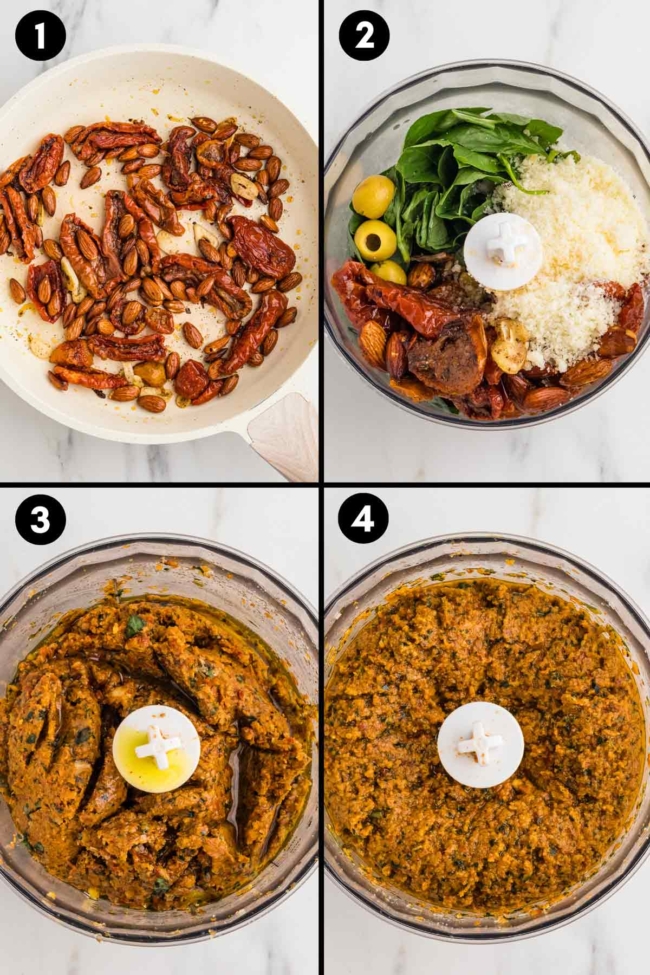
- Toast the ingredients – cook the sun-dried tomatoes, almonds, garlic, and black pepper in a dry skillet over medium heat for about 5 minutes, stirring occasionally. The garlic should begin to brown, the tomatoes should release some of their remaining oil, and the almonds should smell toasted. Transfer everything to a bowl and let it cool for about 5 minutes.
- Process – add the Parmesan, basil, green olives, and toasted ingredients to a food processor. Process until finely chopped.
- Add the olive oil – reduce the processor speed to medium-low and slowly pour in the olive oil.
- Process – continue processing until the pesto is thick, smooth, and easily spreadable. If it’s too chunky, continue processing at medium speed for another minute or two. If it is still too chunky, add another tablespoon of olive oil and process again. If you used dry-packed tomatoes, make sure they were fully rehydrated before making the pesto. Firm or partially rehydrated tomatoes can leave the finished pesto thicker and more textured than expected. If it’s too thin, add a few more almonds or a little grated Parmesan and process again. Add small amounts at a time so you don’t accidentally make it too thick.
Tips for Success
- Use fresh almonds and taste them before adding them. Nuts can sometimes taste bitter or rancid even when they look perfectly fine.
- Don’t skip the brief toasting step. It deepens the flavor of the almonds and garlic and helps the tomatoes release some of their oil.
- Let the toasted ingredients cool for a few minutes before processing them with the basil and cheese.
- Pour the olive oil in slowly while processing so it incorporates evenly into the pesto.
- Don’t worry if the pesto looks quite thick straight from the food processor. When you’re using it as a pasta sauce, starchy pasta water will loosen it and help it coat the noodles.
- For the brightest basil flavor, use fresh basil that hasn’t started to wilt or turn gray.
Can I make this pesto vegan?
Yes. Replace the Parmesan with a plant-based Parmesan or nutritional yeast. Nutritional yeast gives the pesto a savory, cheesy flavor, although it won’t provide quite the same creamy texture as Parmesan.
Why is my pesto too thick?
Add olive oil, 1 tablespoon at a time, and process until the pesto reaches the consistency you want. If you’re using it for pasta, remember that hot pasta water will loosen it considerably, so you don’t need the pesto itself to be thin.
Why is my pesto bitter?
Bitter pesto is often caused by an ingredient that isn’t fresh. Taste the almonds before using them, since nuts can develop a bitter or rancid flavor even when they look normal. Make sure your olive oil is fresh as well, and use basil that is bright green rather than old or grayish.
If the finished pesto tastes slightly bitter, a little extra Parmesan can help balance the flavor. Keep in mind that adding lemon juice can also reduce the perception of bitterness, but it will add acidity that isn’t part of the original recipe.
How to store and freeze
Transfer the pesto to an airtight container and smooth the surface. Pour a thin layer of extra-virgin olive oil over the top to limit its exposure to air, then refrigerate for up to 5 days.
The pesto may darken slightly and become thicker as it sits. When you’re ready to use it, let it sit at room temperature for about 10 minutes and stir well.
To freeze, spoon the pesto into an ice cube tray and cover each portion with a thin layer of olive oil. Freeze until completely solid, then transfer the portions to a freezer-safe bag or container.
Thaw the amount you need in the refrigerator overnight. Stir well and let it sit at room temperature for about 10 minutes before using. If there is excess oil on the surface, simply stir it back in.
How to use sun-dried tomato pesto
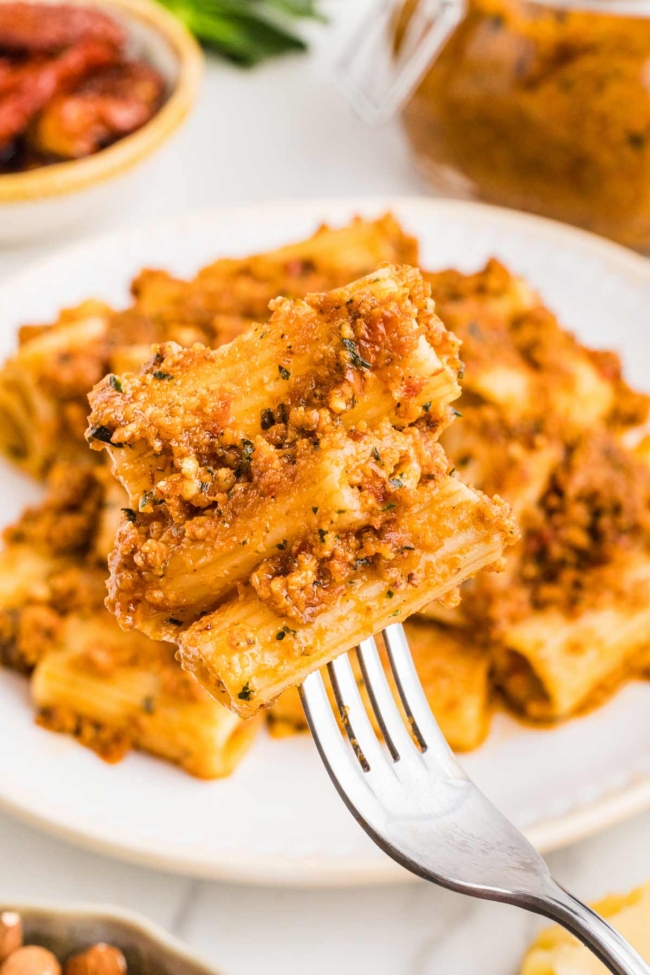
There are plenty of ways to use this pesto beyond pasta. For pasta, start with about 2 generous tablespoons per serving and add a little hot pasta water until the pesto becomes creamy enough to coat the noodles. The starch in the water helps emulsify the oil and pesto into a smooth sauce.
It’s also excellent spread on crusty bread or served with crackers as an easy appetizer. For a simple lunch, use it as a spread in a Mediterranean-style sandwich with roasted vegetables. You can also spoon it over grilled or roasted vegetables or stir a little into pasta salad for extra flavor.
If you enjoy homemade pesto, my Spinach Pesto is another easy version to try. For a pasta dish that already uses homemade pesto, see my Summer Pesto Pasta Salad.
How To Serve Sun-Dried Tomato Pesto
- Toss it with hot pasta and a little pasta water for a creamy sauce.
- Spread it on crusty or toasted bread.
- Serve it with crackers as an easy appetizer.
- Use it as a spread in sandwiches and wraps.
- Spoon it over grilled or roasted vegetables.
- Stir it into pasta salad for extra flavor.
❤️ Have you tried this sun-dried tomato pesto? ❤️
Please leave a ✍️ review and ⭐ rating to let me know how it turned out. I appreciate it so much! 💛
Sun-dried Tomato Pesto
Ingredients
- 8.5 oz (160 grams) jar sun-dried tomatoes in oil, drained but not rinsed about 1 cup
- 1/2 cup (75 grams) almonds
- 2 garlic cloves sliced
- 1/4 teaspoon black pepper
- 1/3 cup (33 grams) freshly grated Parmesan cheese
- 1/2 cup (13 grams) packed fresh basil leaves
- 6 green olives pitted
- 3/4 cup (165 grams) extra-virgin olive oil
For storage:
- 1 tablespoon extra-virgin olive oil
Instructions
- Start by heating a pan over medium heat. Then, add the sun-dried tomatoes, almonds, garlic cloves, and black pepper. Cook over medium heat for 5 minutes, stirring occasionally. The garlic should start to brown, the tomatoes should release some of their leftover oil, and the almonds should toast.8.5 oz (160 grams) jar sun-dried tomatoes in oil, drained but not rinsed1/2 cup (75 grams) almonds2 garlic cloves1/4 teaspoon black pepper
- Then, remove the pan from the heat, transfer the ingredients to a separate bowl, and let them cool for about 5 minutes.
- Once your ingredients have cooled, assemble the pesto. Add to a food processor the Parmesan cheese, fresh basil, green olives, and pan-roasted ingredients. Process at high speed until everything is finely chopped.1/3 cup (33 grams) freshly grated Parmesan cheese1/2 cup (13 grams) packed fresh basil leaves6 green olives
- Then, continue to process at medium-low speed while slowly pouring in the extra-virgin olive oil until your pesto becomes wet and smooth. This will guarantee your pesto is perfectly emulsified, meaning that there will be minimal separation of the oily and the dry ingredients even as you store it over a longer period of time.3/4 cup (165 grams) extra-virgin olive oil
- Transfer the pesto to an airtight container, top it with a thin layer of additional olive oil, and keep it refrigerated. Alternatively, you can use it to dress your pasta right away. You will need about 2 generous tablespoons/portion and a small amount of pasta water to get a perfectly creamy sauce.1 tablespoon extra-virgin olive oil
- The pesto needs to be stored in an airtight container in the fridge. It will keep for up to 5 days. Keep in mind that the pesto will oxidize and slightly thicken over time. To preserve the bright, reddish color, make sure to add a tablespoon of olive oil on top of the pesto or lay some plastic wrap on the surface. When you’re ready to serve the pesto, remove it from the fridge, stir well, and let it rest at room temperature for about 10 minutes.
Notes
- Yields about 1 1/2 cups.
- The nutrition information provided is calculated as a courtesy and is only an estimate. I am not a licensed nutritionist or dietitian. For the most accurate nutritional data, consult a professional or use your preferred calculator.









Leave A Reply!